Art-Kazan: Where art meets data to promote women’s rights

Date:
Art-Kazan: Where art meets data to promote women’s rights

About | Open call | Key dates | Data artworks | Our team | Videos |  Resources

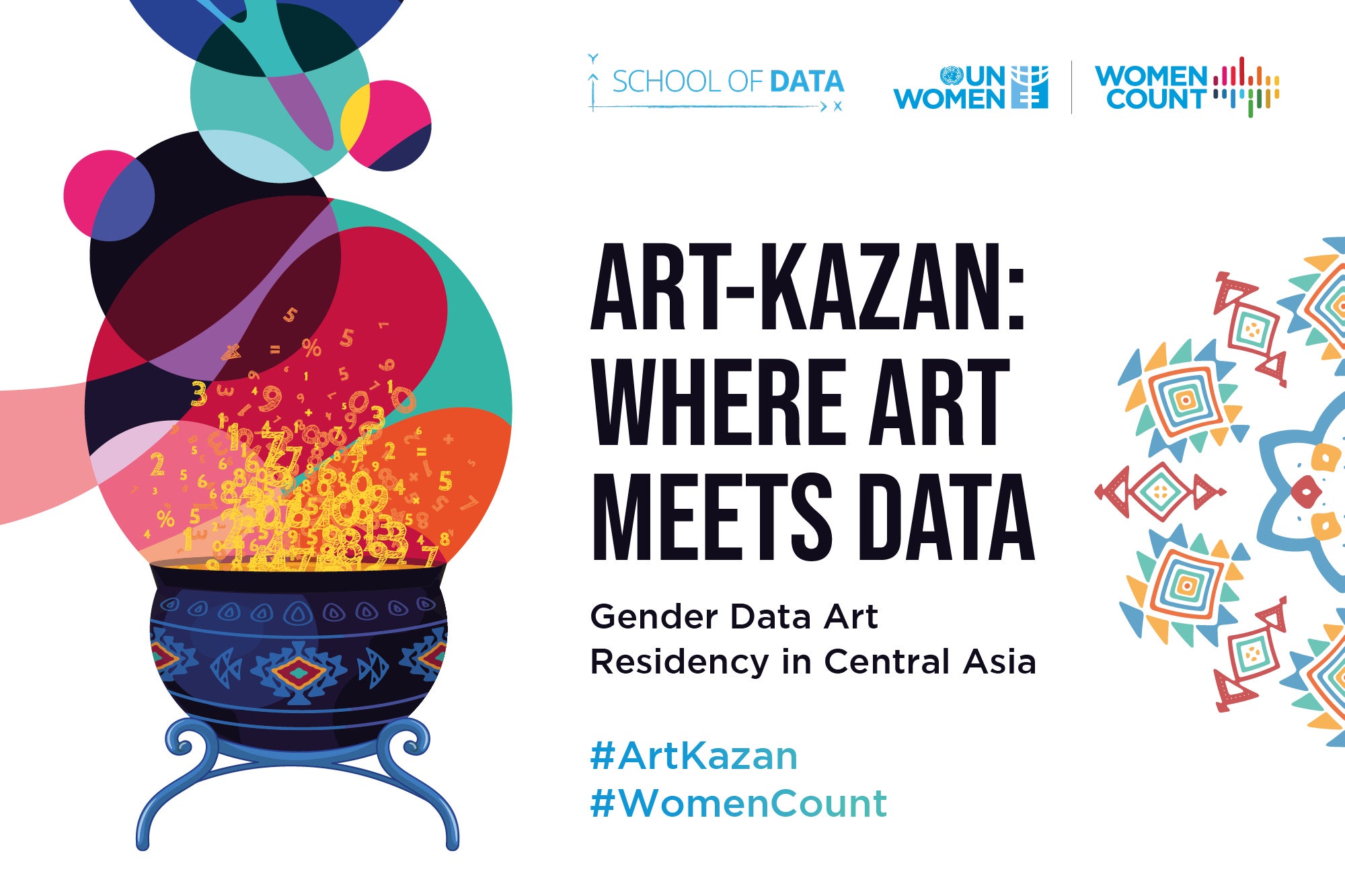
Art-Kazan is a unique initiative by UN Women regional programme “Making Every Woman and Girl Count” and School of Data, designed for creative talents from across Central Asia to participate in an online training of 5 sessions on data art and gender data/analysis, a three-day immersive art residency in the heart of Central Asia, and a platform to showcase their work at an international exhibition. Inspired by the traditional kazan pot, symbolizing unity and shared cultural heritage, Art-Kazan unites artists to integrate gender data into contemporary artworks to champion gender equality and inspire transformative change in Central Asia.

The initiative aims to enhance the data literacy of artists from across Central Asia, enabling them to create engaging and impactful artworks using gender data to bolster discussion and debates on gender equality emerging issues in the region. It also fosters collaboration and networking, sharing diverse perspectives and building a supportive creative community of women’s rights advocates.

Follow the page for news and updates on the “Art-Kazan: Where art meets data” initiative and join the conversation using the hashtags #ArtKazan and #WomenCount.
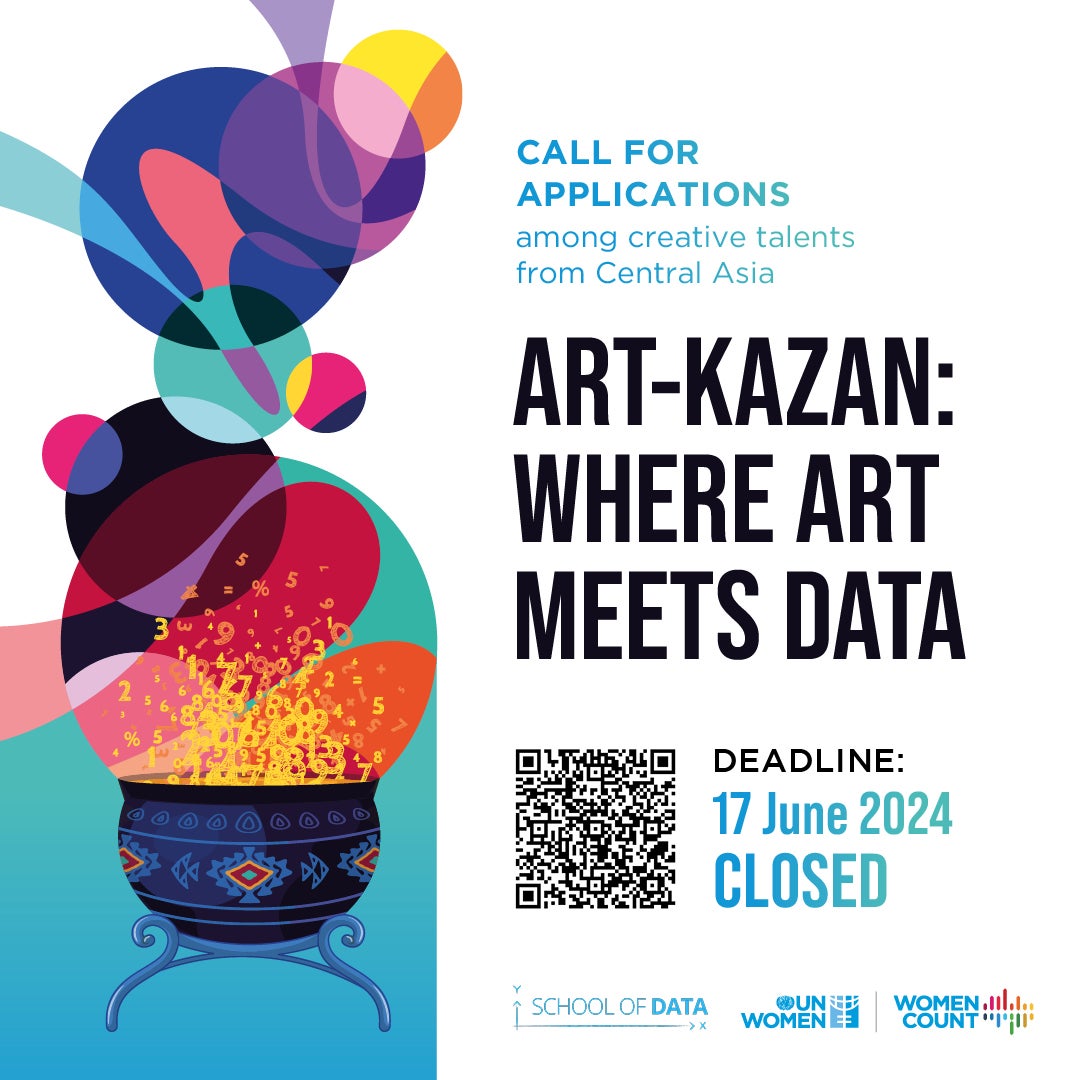
Call for applications [CLOSED]: Art-Kazan: Where art meets data
Art-Kazan: Where art meets data to promote women’s rights

We are excited to announce that the Art-Kazan application phase has successfully ended. We received an impressive 200+ applications from creative talents from across Central Asia and beyond. These applicants come from diverse backgrounds, including the music industry, filmmaking, design, poetry, and street art, showcasing the rich tapestry of creativity in the sub-region.

For more details, please refer to our Flyer and FAQ. A heartfelt thank you to everyone who applied!


Applications in numbers
Total applications received
 
Selected for online training
 
Selected for art residency
 
Presented
art works
 
Key dates

Online Sessions

9 - 24 July 2024

Art Residency

17 - 19 May 2024
Almaty, Kazakhstan

Crafting Data Art Products

September 2024 - June 2025

Data-Art Exhibition

11 - 28 July 2025
Bishkek, Kyrgyzstan

Data-Art Exhibition

5-15 December 2025
Almaty, Kazakhstan

Catalogue of Artworks 

Catalogue of data-art works «Tirek: The Thread of Her Life»

Discover 14 powerful artworks created by artists from across Central Asia. Each piece is grounded in real gender data and brings to light the lived experiences of women and girls in the region — from invisible labour and isolation to economic inequality, discrimination, gender-based violence, and gendered social norms. This collection is both a tribute to women’s resilience and a space for reimagining conventional views on the role of women in society. It is an act of remembrance, of hope and a call to listen – through art and data – to women’s stories, to reflect and to reimagine. Catalogue in English and Russian.

Data artworks

"QizUl: girl or boy?" by Zhanna Assanova

In Kazakhstan, over 82,000 of women & girls bear names that whisper a wish for sons. "QizUl" is a conceptual piece of jewelry that combines the words "qiz" (daughter) and "ul" (son), rethinking the tradition of preferring sons and emphasizing the equal value of each child.

The base of the piece is a top designed to resemble a textile-made newborn's shirt. It features blue flowers of various sizes, whose petals are made from metal zippers, symbolizing the strength and resilience of women in the face of stereotypes.

"SITORAXO: women trailblazers of Uzbekistan" by Sitora Brezhneva

"SITORAXO," which means "stars" in Uzbek, is an inspiring data art visualization paying tribute to 37 prominent Uzbek women-trailblazers over the past 150 years. Created using string art techniques, this wooden panel consists of threads of varying lengths and colours, connected by large and small nails.

Although women have achieved much in the past, they remain underrepresented in many fields. In Uzbekistan, they hold only 35% of seats in parliament and just over a quarter of positions in public administration.

"Illusion of balance" by Anastasia Bunakova

"Illusion of Balance" is a mobile made of handcrafted felt stars, exploring how gender roles are perceived in Kazakhstan through traditional proverbs and sayings. The artwork is based on an analysis of 2,000 proverbs, from which 195 related to gender roles were selected using keywords associated with women and men. These were compiled into a database and categorized by theme, subtheme, referenced roles, and evaluative tone.

In Kazakhstan, gender stereotypes continue to shape societal perceptions. Surveys show that nearly 50% of respondents believe men are better suited for politics, while 44% think they make better business leaders.

"Bitter truth" by Anna Bakaeva

"Bitter truth" is a ceramic installation featuring a teapot and bowls—symbols of family comfort in Central Asia—inviting reflection on domestic violence in Uzbekistan.

The teapot's patterns visualize data on forms of violence, key trends, and perpetrators, including the share of girls subjected to physical punishment during upbringing. In Uzbekistan, nearly 41% of women believe a husband is justified in hitting his wife for reasons such as leaving the house without permission, neglecting chores or children, refusing intimacy, burning food, or expressing disagreement.

"Mono" by Maria Krapp and Galina Shumilina

"Mono" is a vibrant collage installation composed of 226 digitized children's drawings, dedicated to monoparent families in Kazakhstan. The drawings were collected during workshops at an art school in Taraz, where children were asked to depict their families. Each drawing was tagged by family type—two-parent, large, or monoparent—and grouped into three collages.

In Kazakhstan, the number of monoparent families rose to over 780,000 in 2021, a 1.5-fold increase since 2009. 87% are headed by mothers, with 70% living in urban areas. Today, one in five children is raised by a single parent. A 26% gender pay gap further increases the risk of poverty for lone mothers.

“Gul Qiz” by Mastura Hamrayeva

“Gul Qiz” is a textile installation combining the Uzbek words gul (flower) and qiz (girl), created in memory of 200 women killed by femicide in Uzbekistan between 2015 and 2024. Through 200 unique hand-embroidered pieces made of cotton and felt, the artwork sheds light on a deeply silenced issue.

In 2021, Uzbekistan’s femicide rate was 1.05 per 100,000 women, higher than the previous year and surpassing rates in Türkiye and Armenia. From 2014 to 2024, 334 women and girls were killed, with nearly 80% murdered by partners or family members.

"Devalued" by Ekaterina Sanamiants

Blending traditional motifs with data, the exhibit "Devalued" exposes the inequality faced by women in Tajikistan, who earn, on average, just 64% of what men do for the same work.

This dish visualizes wage data across various regions and sectors. The black circle at the center represents women's average monthly wage as a percentage of men's wage, shown in red. The length of each fringe reflects men's wage in a specific sector—making the gender pay gap, illustrated in black, clearly visible.

"Convexity" by Galina Kolomenskaya

"Convexity" is a life-affirming data installation using assemblage techniques to portray the strength and resilience of Kazakh women in the face of breast cancer, superstitions, and societal stigma. The piece features a textured fibreboard panel, a black fleece ribbon, a breast prosthesis, and transparent crystals—symbols of pain, loss, and hope.

Breast cancer is the most common cancer among women in Kazakhstan, accounting for nearly one in four diagnoses. Each year, around 5,000 women are diagnosed, and for one in three, it becomes fatal. With an incidence rate of 36.9 per 100,000, Kazakhstan ranks highest in Central Asia, though its mortality rate has dropped by 40% since 2000.

"Kattama" by Lex Titova

"Kattama" is an oil painting inspired by the layered Kyrgyz flatbread, visualizing gender and age disparities in employment. The dough-like layers resemble a ring chart, symbolizing the unjust labour system in relation to women.

In Kyrgyzstan, most women marry by 24 and become mothers by 28, often leaving or reducing work to care for families. They spend five times more hours on unpaid domestic work than men and typically begin pursuing careers after 35—yet earn 20% less. With retirement at 58, many lack sufficient work experience, resulting in lower pensions and undervalued contributions.

"Balance of colour" by Elena Kisenkova

"Balance of Colour" is a neon-lit acrylic installation designed to inspire young women in Kyrgyzstan to pursue careers in STEM. Despite consistently outperforming boys in national testing, only 10% of girls choose science and technology fields—held back by deep-rooted social norms and gender bias.

Women face significant barriers in the workforce, earning 20% less than men and spending five times more hours on unpaid domestic work. Cultural expectations often push them toward caregiving roles, with 61% of the population viewing higher female earnings as problematic. The artwork challenges these perceptions and highlights the untapped potential of women and girls.

“Women-faced gurama” by Nazilya Guseinova

“Women-faced Gurama” is a wall panel crafted using the traditional Turkmen quilting technique gurama, transforming migration data into a visual narrative. Each triangle represents 1,000 returnees—red for women, beige for men—while stars and diamond shapes reflect age groups and gendered migration patterns.

In Turkmenistan, women migrate more often than men, mostly in search of work and education. Yet in 2020, 53% of returnees were women, with one in three over the age of 65, highlighting the complex demographic shifts shaped by gender and age.

“Voices of silence” by Elvira Sharif

“Voices of Silence” is a relief painting that combines data and art to break the silence about the problem of domestic violence in Kyrgyzstan. Each relief line symbolizes thousands of women’s lives affected by domestic abuse. Minimalist lines and scattered dots emphasize the invisibility of the issue, while stars pay tribute to those whose lives were cut short by domestic violence.

From 2018 to 2022, reported cases rose by 38%, reaching nearly 10,000 in 2022—97% of survivors were women, and 95% of perpetrators were men.

“Lukhtak. Threads of fate” by Bejan Shamsov

“Lukhtak. Threads of Destiny” is an art installation honouring the women whose lives were tragically lost to femicide in Tajikistan. At its center are handcrafted dolls—lukhtak, traditional talismans—reimagined as guardians of untold stories and unfulfilled lives. Each doll reflects personal loss, interwoven with cultural motifs that connect past and present.

Based on recent data, 163 women and children were killed between 2018 and 2024, with 90% murdered by partners or family members. Nearly half died in their own homes, and over 100 children were left orphaned—making visible a tragedy often hidden in silence.

“The circle of Mother Umay” by Meerim Tokocheva

“The Circle of Mother Umay” is a digital data artwork inspired by the Turkic goddess of motherhood, exploring the link between poor maternal nutrition and high maternal mortality in Kyrgyzstan. The piece visualizes how short birth intervals—less than one or two years—combined with widespread nutrient deficiencies, put women’s lives at risk.

Each year, over 11,000 women give birth with less than a one-year gap, and 30,000 space births by no more than two years. 56% of women suffer from iron deficiency, and 83% lack folic acid—raising risks of complications, bleeding, and birth defects. Rural women face the highest mortality, dying three times more often than those in urban areas.

 
Our team

Stefanie Posavec
International Data Visualization and Storytelling
Expert, USA/UK

Nadezhda Andrianova
Designer, Data-Artist,
Data Visualization Trainer, Russia

Altynai Mambetova
Data journalist, Co-founder
of School of Data, Kyrgyzstan

Diana Rahmanova
Artist, Curator, Researcher,
Tajikistan/Kyrgyzstan

Cholpon Tentieva
Curator of the exhibition in Kyrgyzstan

Alexey Juravlev
Data-journalist, urban researcher, Kyrgyzstan

Cholpon Uzakbaeva
Project Manager, co-founder of School of Data

Ala Negruta
UN Women Regional Gender
Statistics Specialist for Europe and
Central Asia

Nurai Mamytova
UN Women Knowledge
Management and Programme
Consultant for
Europe and Central Asia

Meriza Emilbekova
UN Women Communications Analyst
for Europe and Central Asia

Azima Abakirova
SDG Data and Partnership
Coordinator, UN Women Kyrgyzstan

Videos
News and stories
Resources

Watch: Data Art & Storytelling Session

by Stefanie Posavec

Discover how to refine your creative concepts with Stefanie Posavec in our Data Art and Storytelling session at the Art-Kazan residency in Almaty, Kazakhstan. Watch now and check out the presentation for more insights!